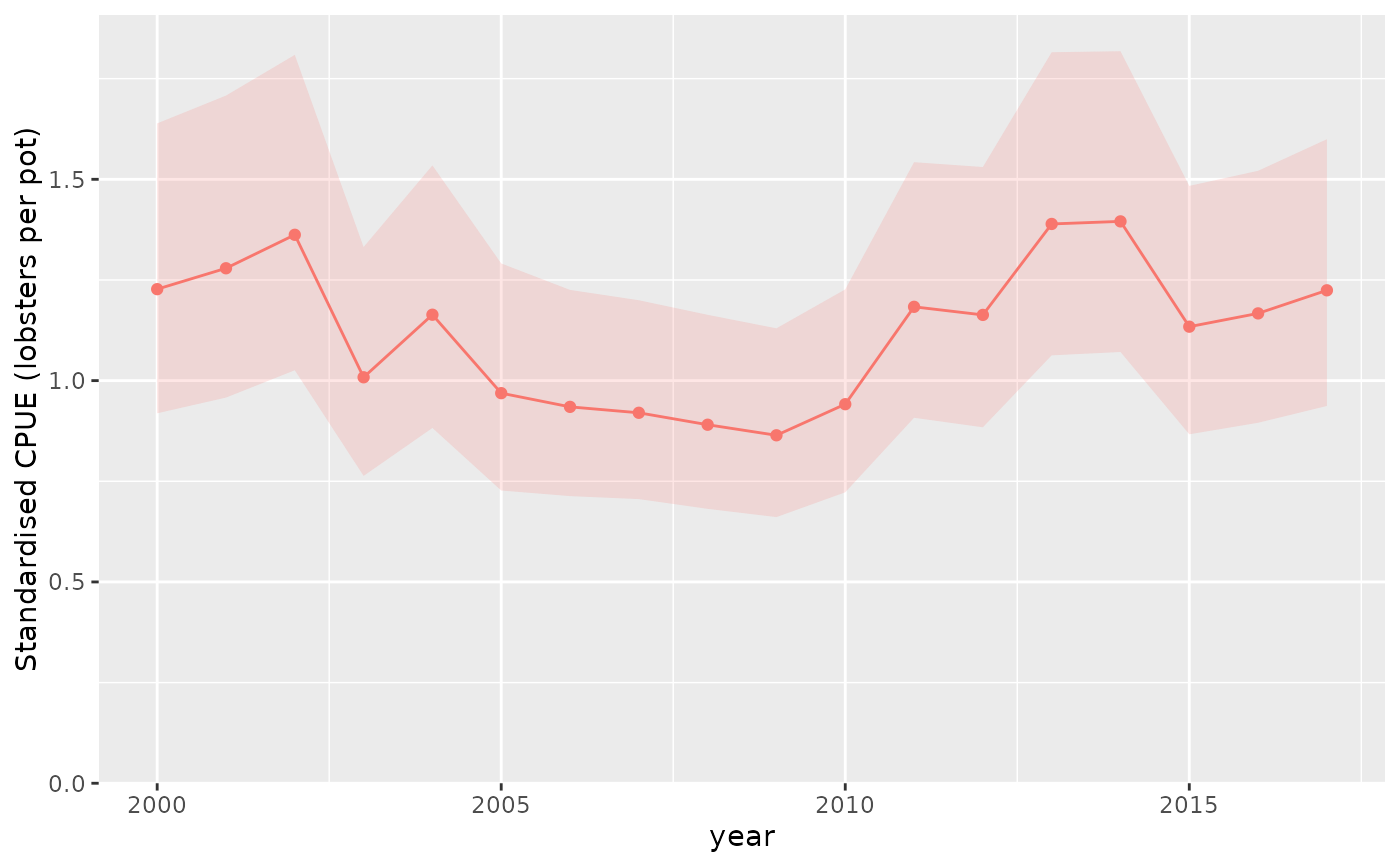
Calculate expected-response indices over the same explicit reference population in every year, or extract the existing year-effect contrasts. No model is fitted or updated by this function.
Usage
cpue_index(
  model,
  year = NULL,
  method = c("standardised", "standardized", "year_effect"),
  reference_data = NULL,
  reference_weights = NULL,
  uncertainty = c("auto", "none"),
  probs = c(0.025, 0.975),
  rescale = "raw",
  ndraws = 1000L,
  batch_size = 250L,
  draw_batch_size = 100L,
  retain = c("summary", "draws"),
  units = NULL,
  ...,
  spatial_fields = c("all", "spatial", "spatiotemporal", "none"),
  seed = 1L,
  prediction_offset = NULL
)

# S3 method for class 'influ_index'
as.data.frame(x, row.names = NULL, optional = FALSE, ...)

# S3 method for class 'influ_index'
print(x, ...)
Arguments
- model
A fitted GLM,
mgcvGAM,glmmTMB, completebrmsfit,sdmTMB, or univariatetinyVASTmodel for response standardisation. Formethod = "year_effect", any model supported byinflu()or an existinginflu_diagcan be supplied.- year
Name of the year variable. Defaults to the native time variable for spatial backends, otherwise the first formula predictor.
- method
"standardised"(default), its alias"standardized", or"year_effect". The latter is a contrast, not an expected-response index.- reference_data
A non-empty data frame defining a common covariate profile or population, without the year column. Each row is predicted in every observed year. Supply all required predictors and any exposure variables explicitly; use one unit of exposure for a per-unit index.
- reference_weights
Non-negative weights, one per reference row. Defaults to equal weights. These are standardisation weights, not areas.
- uncertainty
"auto"for propagated uncertainty, or"none"for a point-estimate preview with missing uncertainty columns.- probs
Two increasing interval probabilities.
- rescale
"raw"(default), or a positive target geometric mean across all returned years. A common normalisation is applied to each posterior draw; frequentist uncertainty includes the normalising denominator.- ndraws
Maximum number of existing posterior draws for brms, or number of joint Gaussian parameter/field draws for spatial backends. The same draw identities are shared across years and prediction batches.
- batch_size
Maximum reference rows predicted together.
- draw_batch_size
Maximum posterior draws predicted together.
- retain
"summary"(default) or"draws". Draw retention is available for standardised brms and spatial indices and stores only a draw-by-year matrix. Spatial draws are a joint Gaussian approximation, not MCMC.- units
Optional response units, such as
"lobsters per pot".- ...
Arguments passed to
influ()only formethod = "year_effect".- spatial_fields
Spatial-backend prediction target:
"all"includes persistent, spatially varying, and spatiotemporal fields;"spatial"excludes spatiotemporal fields;"spatiotemporal"excludes persistent and spatially varying fields;"none"excludes all three. This changes only predictions, not the fitted model. Other smooths/time effects remain.- seed
Non-negative integer seed for spatial joint draws. The caller's random-number state is restored; changing batch sizes preserves draws.
- prediction_offset
For sdmTMB only, the name of a numeric link-scale offset column in
reference_data.NULLexplicitly uses offset zero (one unit of exposure for a log-exposure offset). Other backends obtain offsets from their formula and the supplied reference predictors.- x
An `influ_index` object.
- row.names, optional
Passed to the data-frame method.
Value
An S3 influ_index object containing table, metadata, compact
covariance, and optional draws. as.data.frame() returns the full table with Year, Mean,
Median, SD, CV, Qlower, Qupper, Method, Distribution, and Link.
Details
For standardisation, predictions are averaged on the response scale, not averaged on the link scale and then back-transformed. Supplied reference weights are treated as known. Hurdle and zero-inflated fits use the backend's combined expected response, including its zero component. Binomial GLM/glmmTMB predictions are probabilities; brms binomial expected predictions are counts at the supplied number of trials. Supply one trial for comparable per-trial indices. Log-transformed responses are rejected: fit an explicit lognormal model instead of silently exponentiating a fit.
GLMs and GAMs use the delta method and their joint coefficient covariance.
GAM smooths, including random-effect smooths, are evaluated as fitted; the
smoothing-parameter correction is used when available. glmmTMB uses the
joint fitted-parameter covariance and numerical derivatives of native
response predictions, with conditional random effects set to zero. REML
and zero-component random effects are not yet supported for glmmTMB here.
brms uses brms::posterior_epred() with group-level effects set to zero.
Setting a random effect to zero is not integration over its population
distribution. brms smooths and other population-level terms remain present.
Mean is the fitted expected-response estimate for frequentist models,
and the posterior mean of the expected-response index for brms. Median
is a posterior median and is NA for frequentist estimates, rather than
labelling an MLE as a posterior median. SD is the standard error or
posterior standard deviation of the index, not observation dispersion.
CV is SD / Mean when the mean is positive. Positive frequentist indices
have delta-method log-scale intervals; other indices have normal intervals.
These intervals are pointwise, not simultaneous. Preview mode retains the
brms posterior mean, but omits uncertainty summaries; it does not replace
joint predictions with predictions at posterior-mean coefficients.
Working storage is bounded by reference and draw batches plus a compact
annual covariance or draw matrix. The result retains response-scale and,
when defined, log-index covariance matrices even with retain = "summary".
Use index_vcov() to extract them and index_table() for reporting.
Native prediction code can allocate
additional memory. The result does not retain the model or reference data.
Spatial response estimates evaluate the fitted model at the reference
locations in each observed year. sdmTMB IID group effects are set to zero;
tinyVAST non-spatial temporal effects and smooths remain as fitted. Joint
fixed/latent Gaussian draws propagate field and parameter uncertainty,
with empirical pointwise intervals. Mean remains the plug-in expected
response and Median remains unavailable for these frequentist models.
This is not a Laplace bias-corrected index or integration over a new
population of random effects. Grid predictions are immediately reduced
to annual values; a grid-by-draw array is never retained.
Use integrate_index() for area-weighted totals, which have different units.
Year-effect results preserve the original diagnostic estimand and cannot
be rescaled by this function. These indices are not biomass estimates.
Examples
if (requireNamespace("glmmTMB", quietly = TRUE)) {
  data(lobsters_per_pot)
  fit <- glmmTMB::glmmTMB(lobsters ~ year + depth + (1 | month),
    family = glmmTMB::nbinom2(), data = lobsters_per_pot)
  index <- cpue_index(fit, year = "year",
    reference_data = data.frame(depth = 40), units = "lobsters per pot")
  head(as.data.frame(index))
  plot_index(index)
}