
library(sbt)
library(tidyverse)

theme_set(theme_bw())

article_extdata <- function(file) {
  candidates <- c(
    file.path("inst", "extdata", file),
    file.path("..", "inst", "extdata", file),
    system.file("extdata", file, package = "sbt")
  )
  candidates <- candidates[nzchar(candidates) & file.exists(candidates)]
  if (!length(candidates)) {
    stop("Could not find extdata file: ", file, call. = FALSE)
  }
  candidates[[1]]
}

fixture <- new.env(parent = emptyenv())
load(article_extdata("opt.rda"), envir = fixture)

fit <- sbt_fit(
  fixture$data,
  metadata = list(run = "bundled conditional API fixture")
)
fit <- sbt_add_parameters(fit, parameters = fixture$parameters)
fit <- sbt_add_map(fit, map = fixture$map)
fit <- sbt_add_bounds(fit, bounds = fixture$bounds)
fit <- sbt_build_object(fit)
obj <- sbt_obj(fit)
invisible(obj$fn(fixture$opt$par))
fit <- sbt_add_optimisation(
  fit,
  opt = fixture$opt,
  estimability = check_estimability(obj = obj),
  diagnostics = list(optimizer = list(method = "nlminb", n_passes = 2L)),
  optimizer = "nlminb",
  check = FALSE
)
obj <- sbt_obj(fit)
data <- fit$dataScope
This vignette separates two related tasks:
- simulating observations from a fitted historical likelihood; and
- projecting population dynamics and simulated monitoring data through the CCSBT candidate target procedure (CTP).
Start projections from one accepted fit
Production projections require an accepted
sbt_fitcontaining a compatible, validated posterior. The bundled package optimum is a deliberately restricted API fixture, and the archived MCMC and projection files shipped with earlier package versions are not scientific projection inputs.The executable example below uses the fixture only to demonstrate historical simulation. The complete projection recipe is not evaluated during the website build because it requires an accepted posterior and is computationally expensive.
Historical simulation
Load the package fixture through the current staged fit lifecycle. The RTMB objective is transient and is rebuilt from the stored data and configuration.
Data passed through RTMB’s OBS() mechanism can be simulated from their historical likelihood (Kristensen et al. 2016; Kristensen 2026). The CPUE example in Figure 1 draws from the fitted observation model. It demonstrates the API, not the adequacy of the conditional fixture.
set.seed(102)
plot(
  data$cpue_year,
  data$cpue_obs,
  type = "p",
  pch = 16,
  col = "firebrick",
  xlab = "Year",
  ylab = "CPUE"
)
for (iteration in seq_len(10L)) {
  lines(
    data$cpue_year,
    exp(obj$simulate()$cpue_log_obs),
    col = grDevices::adjustcolor("grey30", alpha.f = 0.35)
  )
}
points(data$cpue_year, data$cpue_obs, pch = 16, col = "firebrick")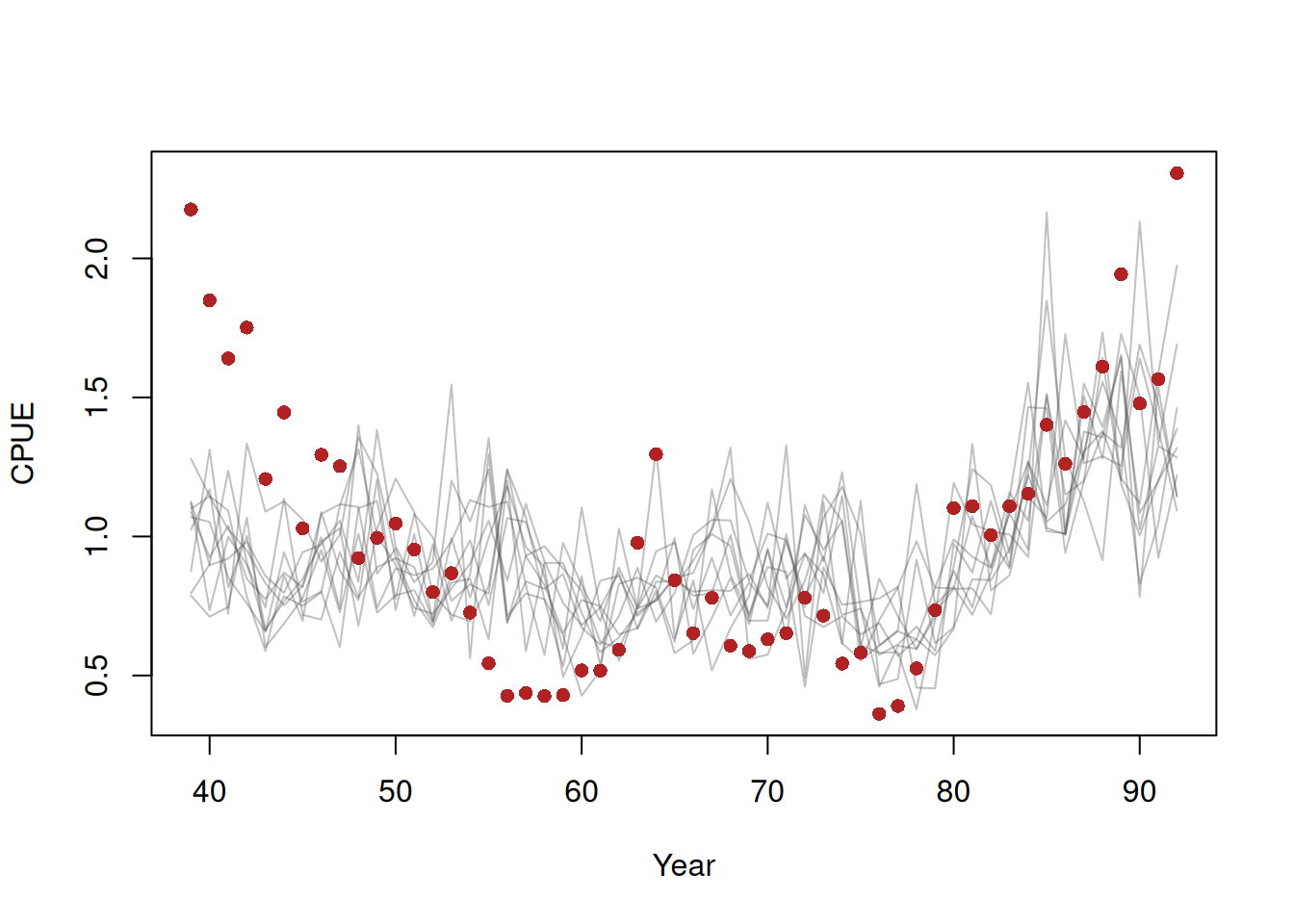
The historical likelihood currently provides simulation for:
cpue_log_obstroll_log_obsaerial_log_obsgt_nrechsp_nKpop_nP
Age- and length-composition components do not all provide simulation methods, so a whole-model checkConsistency() call is not yet available. The component-specific OSA residual functions remain available:
plot_cpue_residuals(fit)
Diagnostic Summary:
  SDNR: 1.83349  (95% CI 1.54128-2.26348; Target: ~1.0)
  MAR:  1.35812  (Target: ~0.67)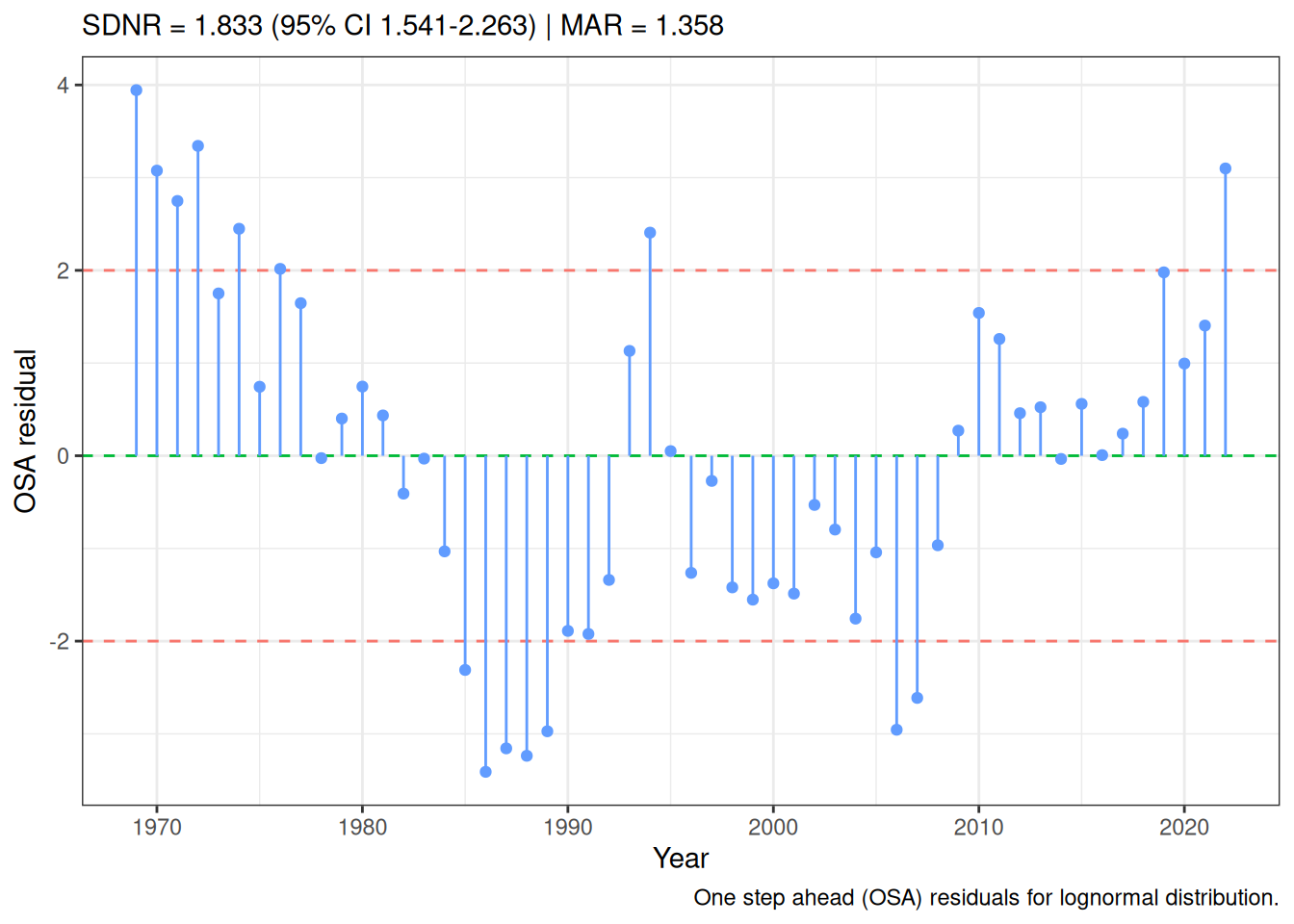
Current projection workflow
The projection workflow keeps the accepted fit intact, adapts its normalized posterior only at the external SparseNUTS boundary, and uses a fresh objective for mutable projection work.
fit <- sbt_fit_read("accepted-base-model.sbt.rds", strict = TRUE)
posterior <- as_tmbfit(fit)
obj <- sbt_obj(fit, fresh = TRUE)

posterior_draws <- SparseNUTS::extract_samples(posterior)
set.seed(44)
iters <- sample.int(nrow(posterior_draws), size = 100L)

first_yr <- 2022L
last_yr <- 2035L
projection_years <- first_yr:last_yr
as_tmbfit() is needed because the low-level projection helpers call SparseNUTS::extract_samples(). The package-owned fit$mcmc remains the portable source of truth.
Recruitment and selectivity
Generate recruitment and selectivity inputs in exactly the same draw order as iters. The example below pins the first projected recruitment deviate to its fitted 2022 value, bootstraps future innovations, retains fitted selectivity through 2025, and then repeats the mean selectivity from 2016–2025.
set.seed(102)
projected_recruitment <- project_rec_devs(
  data = fit$data,
  obj = obj,
  mcmc = posterior,
  first_yr = first_yr,
  last_yr = last_yr,
  samp_years = fit$data$first_yr:(first_yr - 1L),
  iters = iters,
  pin_year = 2022L,
  option = "auto",
  bootstrap = TRUE
)

projected_selectivity <- project_selectivity(
  data = fit$data,
  obj = obj,
  mcmc = posterior,
  first_yr = first_yr,
  last_yr = last_yr,
  samp_years = 2016L:2025L,
  iters = iters,
  option = "mean_last",
  n_years = 10L,
  retain_fitted_through = 2025L
)
project_rec_devs() changes the caller’s random-number state, so set the seed explicitly. project_selectivity(option = "mean_last") is deterministic; option = "lognormal" also consumes random numbers.
CTP calendar
project_ctp_schedule() makes the TAC-update and data-availability assumptions visible before a costly run. Table 1 shows the current ESC31 example: historical dynamics through 2025, four fixed future TAC years, and a CTP update every three years thereafter.
ctp_schedule <- project_ctp_schedule(
  first_yr = 2022L,
  last_yr = 2035L,
  data_last_yr = 2025L,
  fixed_catch_n_years = 4L,
  tac_schedule = 3L,
  tac_calculation_lag = 2L,
  catch_data_lag = 3L,
  cpue_data_lag = 3L,
  gt_data_lag = 4L,
  ckmr_data_lag = 8L
)
knitr::kable(ctp_schedule)| year | tac_change | tac_calculation_year | catch_data_year | cpue_data_year | gt_data_year | ckmr_data_year | ctp_update |
|---|---|---|---|---|---|---|---|
| 2026 | hardwired | 2022 | NA | NA | NA | NA | FALSE |
| 2027 | hardwired | 2025 | 2024 | 2024 | 2023 | 2019 | FALSE |
| 2028 | hardwired | NA | 2025 | 2025 | 2024 | 2020 | FALSE |
| 2029 | hardwired | NA | 2026 | 2026 | 2025 | 2021 | FALSE |
| 2030 | Yes | 2028 | 2027 | 2027 | 2026 | 2022 | TRUE |
| 2031 | No | NA | 2028 | 2028 | 2027 | 2023 | FALSE |
| 2032 | No | NA | 2029 | 2029 | 2028 | 2024 | FALSE |
| 2033 | Yes | 2031 | 2030 | 2030 | 2029 | 2025 | TRUE |
| 2034 | No | NA | 2031 | 2031 | 2030 | 2026 | FALSE |
| 2035 | No | NA | 2032 | 2032 | 2031 | 2027 | FALSE |
Run and cache the CTP projection
The high-level runner validates every selected historical biological state, simulates future monitoring observations, applies the CTP at scheduled update years, and checks projected dynamics. It records nominal TAC separately from biological removals, so any fleet-specific removal multipliers must be supplied explicitly.
projection <- run_projections(
  data = fit$data,
  object = obj,
  mcmc = posterior,
  first_yr = first_yr,
  last_yr = last_yr,
  n_iter = length(iters),
  iters = iters,
  seed = 102L,
  cores = 4L,
  fixed_catch_n_years = 4L,
  fixed_projection_tac = c(22670.91, 23647, 23647, 23647),
  ctp_tac_schedule = 3L,
  ctp_tac_calculation_lag = 2L,
  ctp_catch_data_lag = 3L,
  ctp_cpue_data_lag = 3L,
  ctp_gt_data_lag = 4L,
  ctp_ckmr_data_lag = 8L,
  projection_removal_multiplier_f = c(
    LL1 = 1.11,
    LL2 = 1,
    LL3 = 1,
    LL4 = 1,
    Indonesia = 1,
    Australia = 1.20
  ),
  rdev_y = projected_recruitment$proj_rdev_y[
    , as.character(projection_years), drop = FALSE
  ],
  sel_fya = projected_selectivity,
  cache_file = "projection-cache.rds",
  overwrite = FALSE,
  cache_only = FALSE,
  verbose = TRUE
)
If exact fleet allocation proportions are part of the scientific contract, supply them with projection_tac_split_yf or projection_tac_split_f; otherwise the runner uses its documented recent-allocation rule.
Compatible caches are checked against the projection inputs and internal scientific contract before reuse. New caches are written atomically. A cache hit is convenient, but acceptance still requires the saved diagnostics and reported outputs to be reviewed.
Paired scenarios
For scenario comparisons, reuse the same posterior rows, recruitment, selectivity, projection seed, TAC assumptions, and allocation. Change only the scenario input. This common-random-number design makes differences attributable to the scenario rather than Monte Carlo noise.
Gene-tag release years and recapture or harvest-sampling years are separate controls:
gt_skip_projection <- run_projections(
  data = fit$data,
  object = obj,
  mcmc = posterior,
  first_yr = first_yr,
  last_yr = last_yr,
  n_iter = length(iters),
  iters = iters,
  seed = 102L,
  cores = 4L,
  fixed_catch_n_years = 4L,
  fixed_projection_tac = c(22670.91, 23647, 23647, 23647),
  ctp_tac_schedule = 3L,
  ctp_tac_calculation_lag = 2L,
  ctp_catch_data_lag = 3L,
  ctp_cpue_data_lag = 3L,
  ctp_gt_data_lag = 4L,
  ctp_ckmr_data_lag = 8L,
  gt_skip_years = c(2026L, 2028L, 2030L, 2032L, 2034L),
  gt_skip_recapture_years = c(2027L, 2029L, 2031L, 2033L, 2035L),
  projection_removal_multiplier_f = c(
    LL1 = 1.11,
    LL2 = 1,
    LL3 = 1,
    LL4 = 1,
    Indonesia = 1,
    Australia = 1.20
  ),
  rdev_y = projected_recruitment$proj_rdev_y[
    , as.character(projection_years), drop = FALSE
  ],
  sel_fya = projected_selectivity,
  cache_file = "projection-gt-skip-cache.rds"
)
The exact skip vectors above are illustrative. Record the chosen release and recapture schedule alongside every result so that “alternate-year gene tagging” is unambiguous.
Reviewing projection results
At minimum, review:
- the MLE and posterior acceptance records in the source fit;
- the selected-draw plan and historical biological-state diagnostics;
- CTP status and input snapshots for every draw and update year;
- finite, feasible population trajectories;
- nominal TACs separately from biological removals;
- paired TAC and stock-status differences by year; and
- Monte Carlo uncertainty, especially for short screening runs.
The returned ctp_total_tac_iy matrix contains draw-by-year nominal TACs, while ctp_total_removal_iy contains the corresponding removals after multipliers. For a paired comparison, summarize the within-draw differences rather than comparing two unrelated marginal summaries:
tac_difference <- gt_skip_projection$ctp_total_tac_iy -
  projection$ctp_total_tac_iy

data.frame(
  Year = projection$projection_years,
  Median_difference = apply(tac_difference, 2L, median),
  Lower_95 = apply(tac_difference, 2L, quantile, probs = 0.025),
  Upper_95 = apply(tac_difference, 2L, quantile, probs = 0.975)
)
A 100-draw run is useful for screening and checking implementation behaviour. It is not automatically adequate for final tail probabilities or management advice; those require a draw-count sensitivity check and the full acceptance workflow.
References
Kristensen, Kasper. 2026. RTMB: ’R’ Bindings for ’TMB’. https://doi.org/10.32614/CRAN.package.RTMB.
Kristensen, Kasper, Anders Nielsen, Casper W. Berg, Hans Skaug, and Bradley M. Bell. 2016. “TMB: Automatic Differentiation and Laplace Approximation.” Journal of Statistical Software 70 (5): 1–21. https://doi.org/10.18637/jss.v070.i05.